VectrixLab
Back to work
  • Auction curation
  • Product concept

Gavelmere

An auction catalog workspace for lot descriptions, condition review and sale sequencing.
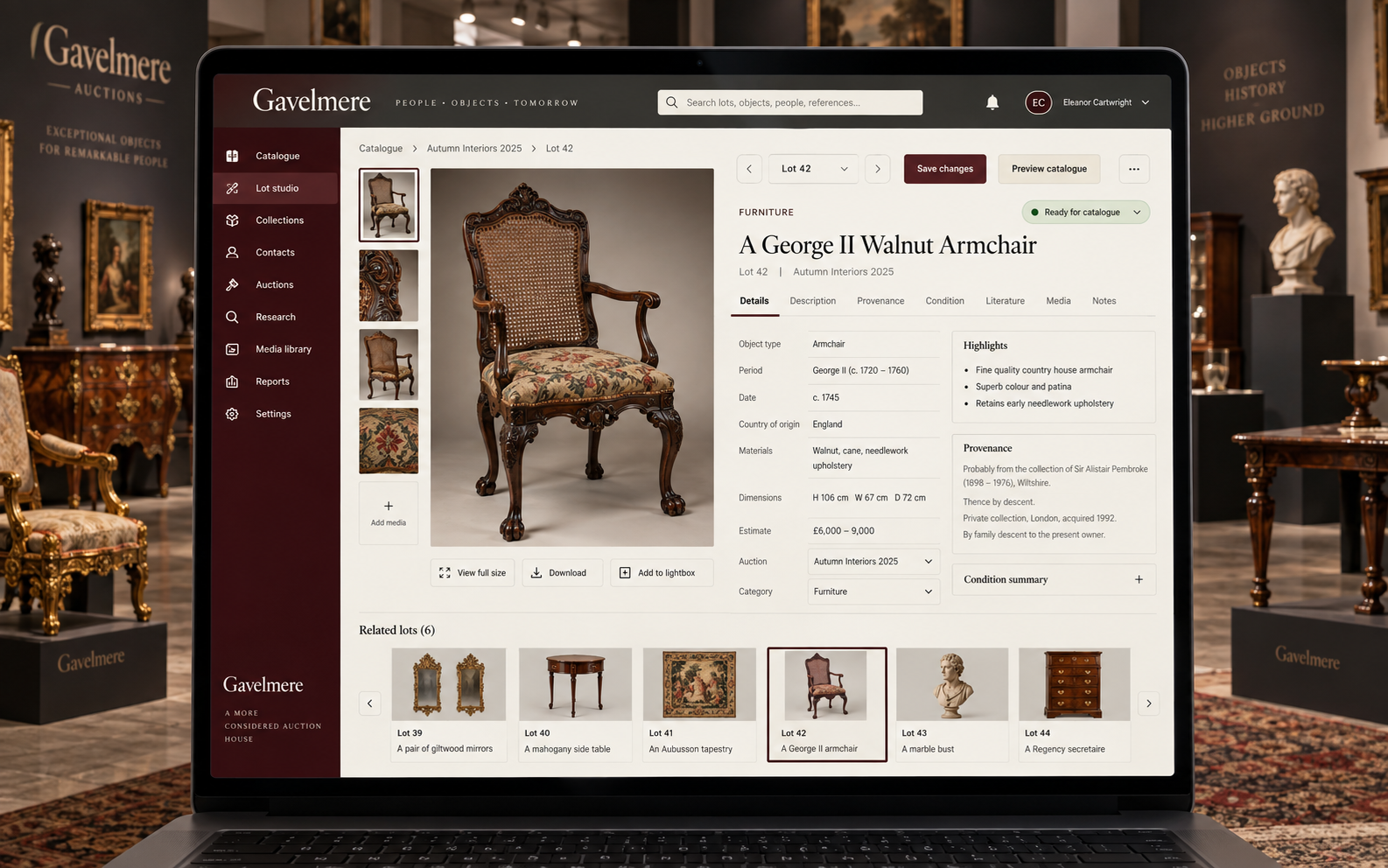
Gavelmere product concept in a branded setting

Project overview

Gavelmere explores the editorial work behind an auction catalog. An object-first studio gives photography and description equal attention, while condition notes, sequence planning and catalog proofing connect the record to its eventual presentation. All lots and provenance details are illustrative; the portfolio does not claim authentication or valuation services.

The challenge

Preparing a catalog means coordinating photographs, descriptions, condition observations and ordering decisions. A late change to a lot can be difficult to trace when its record and page proof are reviewed separately.

  • Keep descriptive content connected to object imagery.
  • Attach condition notes to the relevant visible detail.
  • Preserve lot identity as the sale sequence and proof evolve.

Our solution

An editorial catalog workspace uses a compact collection rail. Lot editing emphasizes the object, sale sequencing uses an ordered visual grid, condition review uses magnified annotations and proofing displays the publication spread.

  • Develop a lot description beside its photograph and illustrative record notes.
  • Arrange an ordered sale sequence using object thumbnails and section dividers.
  • Inspect object details with numbered annotations and condition observations.
  • Review a catalog spread with typography controls and editorial comments.

Key features

  • Lot studio

    Develop a lot description beside its photograph and illustrative record notes.

  • Sale sequence

    Arrange an ordered sale sequence using object thumbnails and section dividers.

  • Condition review

    Inspect object details with numbered annotations and condition observations.

  • Catalog proof

    Review a catalog spread with typography controls and editorial comments.

  • Lot records

    Gather descriptive fields and image references together.

  • Photo selection

    A proposed image picker identifies the preferred catalog view.

  • Sequence sections

    Group lots into readable sale chapters.

  • Condition pins

    Connect observations with a specific image detail.

  • Provenance notes

    Store illustrative documentation references with the object.

  • Proof comments

    Discuss layout changes beside the page.

  • Revision history

    A proposed history tracks catalog content changes.

  • Editorial checklist

    Track preparation tasks for the selected lot.

Technology stack

    The results

    Four views connect object records to condition review, sequencing and publication proofing. A next evaluation would follow an editor from a changed lot description to its current catalog placement.

    • 4Specialized concept views

    • 12Proposed feature areas

    Ready to build something similar?

    Let's bring your idea to life

    Whether it's a platform for your industry or something completely different, we can help you build, integrate and scale.